How Indian Manufacturers and Traders Can Manage Collections and Reduce Outstanding Payments Using ERP
Introduction
For Indian manufacturers and trading companies, outstanding receivables are not just a finance problem — they are an operational crisis in slow motion. The average Indian B2B business runs 60–90 days of revenue as outstanding receivables at any given time. For a ₹2 crore monthly revenue company, that is ₹4–6 crore of cash that customers owe but have not paid — cash that is funding working capital through overdraft at 12–15% interest.
The problem is almost never that customers refuse to pay. It is that nobody is systematically following up. Collections follow-up in most Indian SMEs happens informally — a call when someone remembers, a WhatsApp message when the accountant flags it, and a reminder at month-end when the pressure builds. This guide explains how Indian businesses can build a systematic collections process using ERP.
Why Collections Fail in Indian SMEs — The Root Causes
The collections problem in Indian businesses is almost always an information problem, not a relationship problem. The sales team does not follow up consistently because:
- They don't know who owes what without calling the accountant. Getting an outstanding report from Tally requires the accountant to pull it — and if the accountant is busy or absent, the collections call does not happen.
- They don't know which invoices are overdue vs. current. A customer with ₹5 lakh outstanding might have ₹2 lakh that is 90+ days overdue and ₹3 lakh that is within credit terms. Without aging analysis, every conversation is the same — "please pay" — rather than a targeted follow-up on the specific overdue amount.
- There is no accountability for collections targets. When collections is everyone's informal responsibility, it becomes nobody's formal responsibility. The sales team's incentive is to close the next order — not to collect on the previous one.
- Credit limits are not enforced. New orders get dispatched to customers who are already beyond their credit limit because nobody checks the outstanding before confirming the order. This makes the collections problem worse with every cycle.
💡 Quick Tip: Count how many customers in your top 20 are currently beyond their approved credit limit. If more than 3 are, your credit policy is not being enforced at order confirmation — and your collections problem will compound until it is.
The Collections Process That Actually Works for Indian Businesses
Effective collections in Indian B2B businesses requires four things: visibility, accountability, systematic follow-up, and credit enforcement. Here is how each works in practice.
Step 1: Real-Time Outstanding Visibility — Without the Accountant
The first step is making outstanding data available to the sales and collections team without requiring a Tally report. When a salesperson can open their phone, see that Customer A owes ₹3.2 lakh with ₹1.8 lakh overdue by 45 days, and make a targeted collections call — that is when follow-up actually happens.
QuickBiz ERP integrates with Tally Prime and surfaces outstanding data from Tally into the QuickBiz collections dashboard. The sales team sees their customers' balances and overdue amounts in real time, without Tally access, without calling the accountant. Collections calls become a daily habit rather than a monthly scramble.
Step 2: Ageing Analysis — Know Exactly What to Chase
Not all outstanding is equally urgent. An invoice that is 8 days overdue needs a polite reminder. An invoice that is 75 days overdue needs a direct conversation with the customer's decision-maker. Treating all outstanding the same is one of the most common collections mistakes.
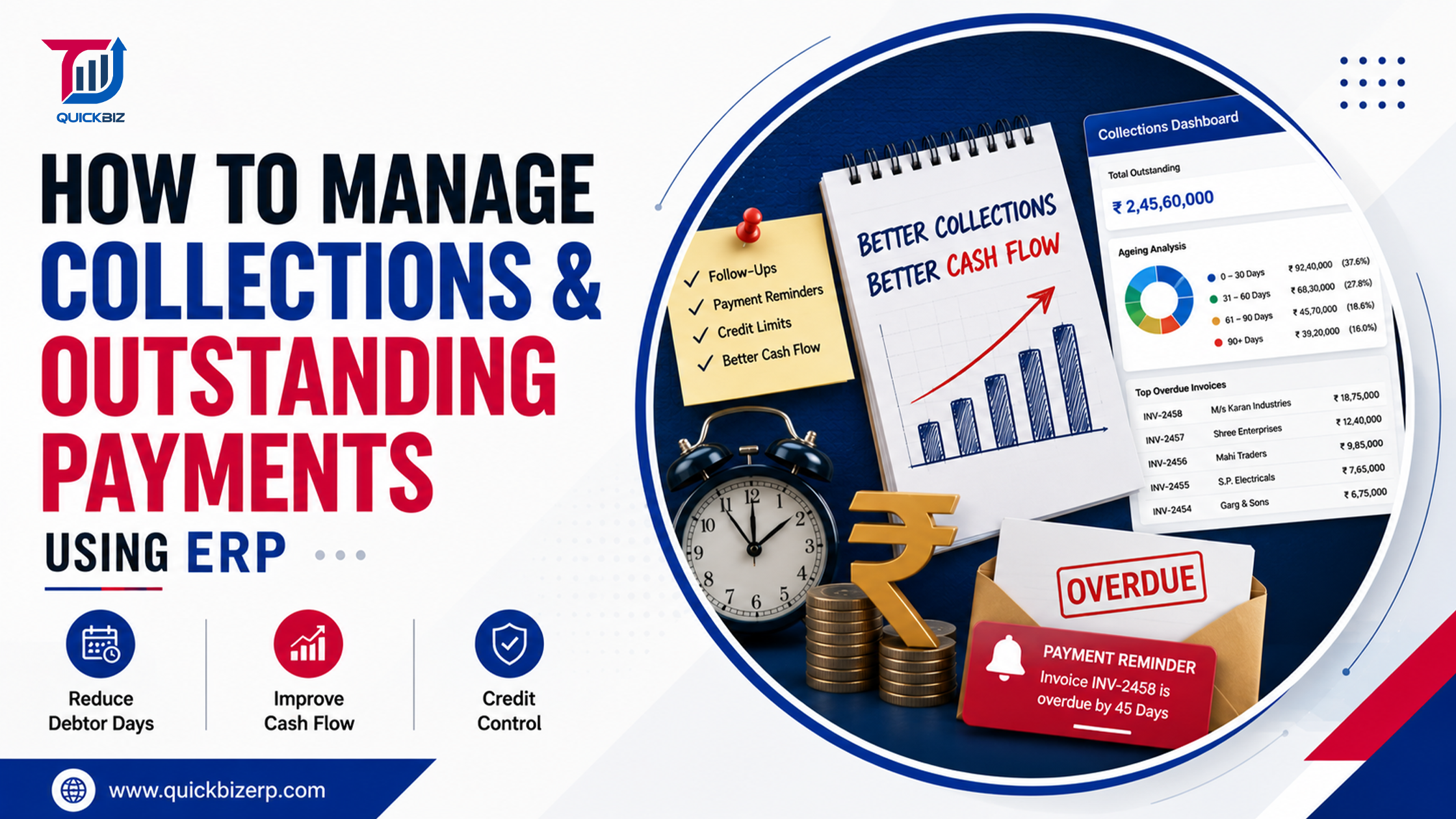
The QuickBiz collections dashboard shows outstanding by age bucket:
- 0–30 days (current — within or just past terms)
- 31–60 days (first follow-up required)
- 61–90 days (active collections priority)
- 90+ days (escalation required — owner or senior follow-up)
This segmentation allows the collections team to prioritise their calls each morning — starting with the largest and oldest balances, not whatever they happen to remember.
💡 Quick Tip: In a typical Indian manufacturing or trading company, 30% of the outstanding value is in the 90+ day bucket — but only 10% of customers are responsible for it. Identifying and escalating these 10% should be the owner's personal priority, not the junior sales team's informal task.
Step 3: Systematic Follow-Up Scheduling
The difference between companies that collect well and those that don't is almost never the relationship with the customer — it is whether follow-up is scheduled or reactive. Reactive follow-up happens when someone remembers or when the pressure builds. Scheduled follow-up happens on a defined day, with the specific invoice reference, from the correct person.
QuickBiz ERP allows the collections team to set follow-up reminders against specific invoices — "Call Customer X on Thursday about Invoice #2847 for ₹1.2 lakh due 45 days ago." The reminder appears in the team member's dashboard on the scheduled day. Nothing falls through the cracks because the system tracks it — not someone's memory.
Step 4: Credit Limit Enforcement at Order Confirmation
The most effective collections tool is preventing the problem from getting worse. When a customer is at or beyond their credit limit, the next sales order should not be confirmed until the outstanding is partially paid. In most Indian SMEs, this check does not happen — the sales team confirms the order to meet their revenue target and the collections problem compounds.
QuickBiz ERP flags orders from customers who are beyond their credit limit at the point of order confirmation — before dispatch, before the invoice is raised, before the goods leave the warehouse. The sales manager either gets the customer to make a payment against the outstanding before the order is processed, or escalates to the owner with a specific recommendation. This single feature, consistently applied, typically reduces the 90+ day outstanding bucket by 40–60% within 6 months.
Step 5: Salesperson Accountability and Collections Targets
In most Indian companies, salespeople are measured on orders booked, not on collections. This creates a systematic incentive to sell more to customers who are already slow payers — increasing revenue on paper while increasing outstanding in practice.
QuickBiz ERP generates salesperson-wise collections reports showing each salesperson's outstanding balance, overdue percentage, and average collection period. When sales team performance reviews include collections data alongside new order data, the incentive structure changes — and collections improve without any additional staff or resources.
💡 Quick Tip: Set a simple rule: no salesperson earns commission on a sale until the payment from that sale has been collected. This single policy change reduces outstanding more effectively than any collections team activity, because it aligns the incentive correctly from the first transaction.
What This Means in Practice: A Real Working Capital Calculation
For a ₹2 crore monthly revenue Indian trading company with 75-day average debtor days:
- Current outstanding: ₹5 crore (75 days × ₹2 crore / 30 days)
- Working capital cost at 13% overdraft rate: ₹65 lakh per year
- Reducing debtor days to 55 days through systematic collections: outstanding drops to ₹3.7 crore
- Working capital freed: ₹1.3 crore
- Annual interest saving: ₹17 lakh
A 20-day improvement in debtor days — achievable within 6 months of implementing systematic collections — saves ₹17 lakh per year in a ₹2 crore monthly revenue business. This is the financial return from better collections management, and it requires no additional headcount — only better information and better process.
Conclusion
Collections management is not a finance function — it is an operational discipline that requires the right information, the right accountability structure, and the right tools. For Indian manufacturers and trading companies, ERP with Tally integration provides the collections dashboard, ageing analysis, follow-up scheduling, and credit enforcement that transforms collections from a reactive crisis into a systematic process. If your business has significant outstanding receivables and no systematic collections process, speak to our team to see how QuickBiz ERP's collections module works for your industry.