ERP for Wire and Cable Manufacturers in India: BOM Management, Job Costing, and Tally Integration
Introduction
Wire and cable manufacturing is one of India's most complex SME industries from an operational perspective. A single finished cable can have 8–15 raw material components across multiple sub-assemblies — copper conductor, insulation material, bedding, armouring, outer sheath — each with its own consumption rate, scrap percentage, and supplier. Managing production, inventory, and costing for this across 20–30 SKUs using Excel and Tally creates operational blind spots that directly eat into margins.
This guide is written specifically for wire and cable manufacturers in India — particularly those in Gujarat (Rajkot, Jamnagar, Surat), Maharashtra (Mumbai, Pune, Nashik), and Uttar Pradesh — who are evaluating ERP to replace their current Excel and Tally combination.
The Specific Operational Problems Wire and Cable Manufacturers Face
Before discussing ERP features, it is worth naming the problems wire and cable manufacturers specifically experience — because generic ERP content never addresses them accurately.
- Multi-component BOM complexity: A 4-core armoured cable has different copper cross-sections per core, different insulation materials per conductor, bedding tape, armouring wire, and outer sheath — all in specific quantities per 100 metres of finished cable. Managing this BOM across multiple cable types in Excel is error-prone. A BOM error means every production batch is consuming wrong material quantities — and the loss is invisible until a physical stock audit.
- Scrap and yield variability: Wire drawing, stranding, and insulation processes all produce scrap. The scrap percentage varies by machine, by shift, and by conductor material grade. Without tracking actual scrap per production batch, the manufacturer cannot calculate true job cost — and is pricing products based on theoretical BOM rather than actual consumption.
- Copper price volatility: Copper is priced daily and fluctuates significantly. A cable order accepted in January at a specific price may be produced in February when copper has moved 5–8%. Without job costing that uses actual copper consumption at actual rates, margin analysis is meaningless.
- Cut-length order management: Cable orders are typically in metres or coils of specific lengths. Managing cut-length orders, remnant lengths, and minimum wastage across production runs requires specific inventory management that generic ERP does not handle without customisation.
- Drum and reel tracking: Finished cable is wound on drums or reels that have their own tracking requirements — which drum holds which cable type, what length, at what production batch, with which test report. Without this, the dispatch team ships wrong cables or the wrong drum to the wrong customer.
💡 Quick Tip: Calculate the scrap percentage for your last 10 production batches by comparing raw material issues from store versus actual cable produced. If you cannot do this in 30 minutes from your existing records, your production data is not captured at the level needed for accurate costing.
How ERP Solves These Problems for Wire and Cable Manufacturers
BOM Management for Multi-Component Cable Designs
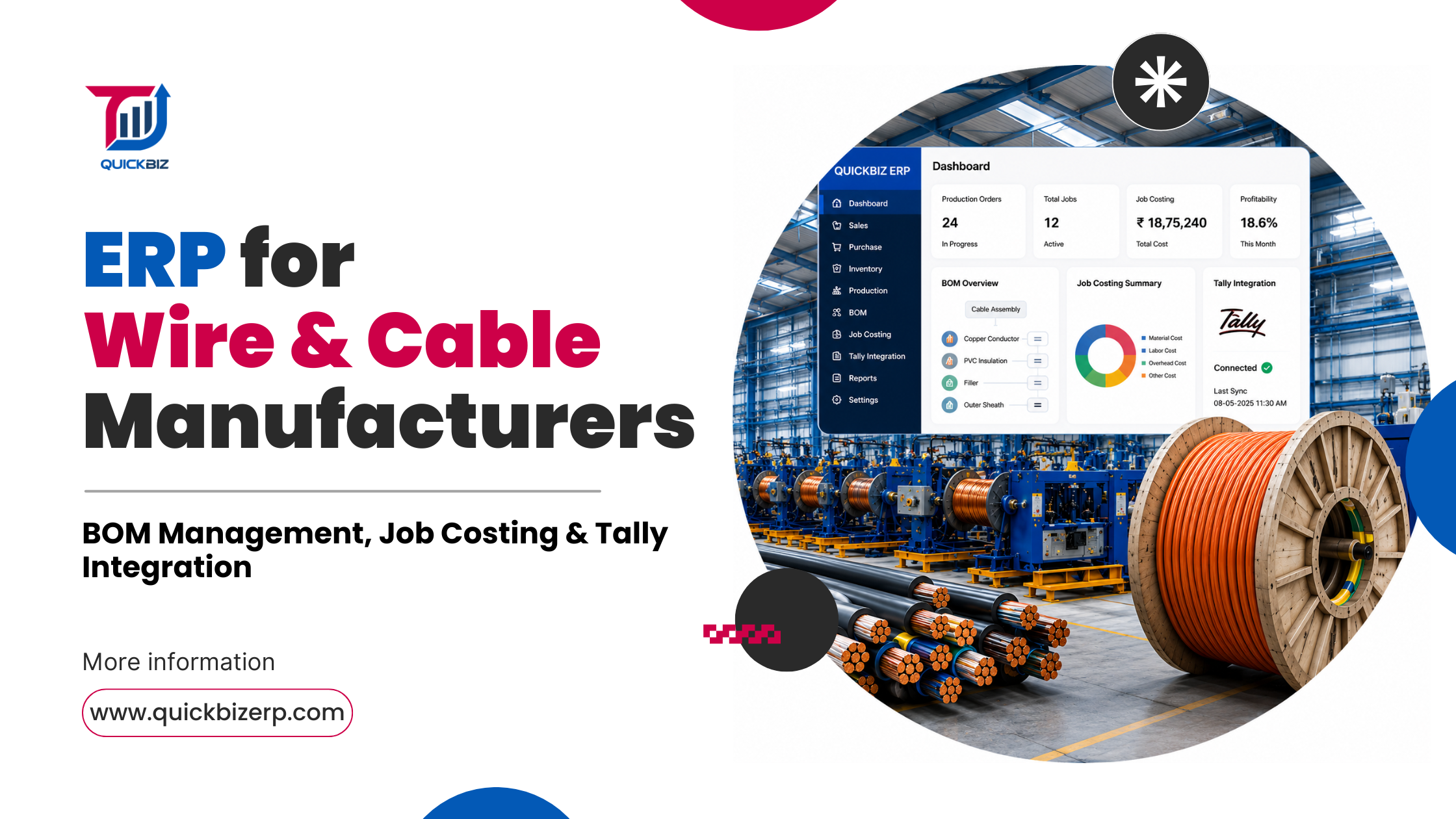
QuickBiz ERP supports multi-level BOM with sub-assembly structures — essential for cable manufacturing. The BOM for a finished 4-core armoured cable can be defined with:
- Sub-assembly 1: Conductor (copper rod → drawn wire → stranded conductor per core)
- Sub-assembly 2: Insulated core (conductor + insulation material, by core colour)
- Sub-assembly 3: Cabled assembly (4 insulated cores + bedding tape + filler)
- Finished good: Armoured cable (cabled assembly + armouring wire + outer sheath + drums)
Each level has its own quantity, unit of measure, scrap allowance, and labour cost. When a production order is raised against this BOM, the system issues raw materials from store in the exact quantities required and tracks actual consumption versus planned — highlighting variances immediately.
Scrap Tracking and Actual Job Costing
For every production batch, QuickBiz captures actual raw material consumption (what was actually issued from store), actual scrap recovered (copper scrap, insulation trim, etc.), and actual output (metres of cable produced). The job cost is calculated from these actuals — not from the BOM estimate.
This means the production manager can see, at the end of each shift, whether the batch ran at planned efficiency or whether scrap exceeded the BOM allowance. For a copper-intensive product where copper represents 60–70% of material cost, even a 1% scrap variance is financially significant.
💡 Quick Tip: For a ₹10 crore monthly revenue wire manufacturer with 65% copper content, a 1% scrap overrun costs approximately ₹65,000 per month — ₹7.8 lakh per year. This is the value of accurate job costing data from ERP.
Inventory Management for Wire and Cable Raw Materials
Wire and cable manufacturing uses raw materials with specific properties that standard inventory management does not handle well — conductor cross-section sizes, insulation material grades, colour coding per core, and armouring wire specifications. QuickBiz ERP supports item variants and specifications so that "Copper Conductor 2.5 sqmm" and "Copper Conductor 4 sqmm" are tracked separately even though they are the same material in different sizes.
Reorder alerts are set per material variant, per location — so the store manager knows when 2.5 sqmm copper stock is approaching reorder level without checking every item daily.
Tally Integration for GST-Compliant Cable Invoicing
Cable and wire products have specific GST rate structures — different rates may apply to different cable types, and e-way bills are required for inter-state sales above threshold. QuickBiz ERP generates GST-compliant sales invoices with the correct HSN codes and tax rates for each cable product, and syncs them to Tally Prime automatically. The accounts team continues filing GST returns from Tally without any change to their workflow.
Customer Outstandings and Collections for Cable Distributors
Wire and cable is sold through dealers, contractors, and project buyers — often on credit terms. Managing outstanding payments from 50–100 dealers without a collections dashboard means the sales team is either following up blindly or not following up at all. QuickBiz gives the sales team a live view of each dealer's outstanding balance, overdue invoices, and credit limit status — without needing the accountant to pull a Tally report.
Conclusion
Wire and cable manufacturing is one of the Indian industries where ERP delivers the clearest, most measurable ROI — specifically through accurate BOM management, scrap tracking, and job costing. The difference between a manufacturer who knows their actual copper consumption per batch and one who estimates it is typically 2–3% margin improvement on a copper-intensive product. At ₹10 crore monthly revenue, that is ₹20–30 lakh per year. If you manufacture wire or cable in India and want to see how QuickBiz ERP handles your specific BOM structure and production workflow, speak to our team for a demo tailored to your production process.